
In today’s fast-paced digital world, businesses generate massive amounts of data every second – from customer interactions on social media to internal operational metrics. Simply collecting this data is not enough, the real challenge lies in turning it into meaningful insights that drive smarter decisions. This is where Social Business Intelligence (Social BI) comes into play. By combining traditional business intelligence practices with social and digital data, Social BI enables organizations to monitor trends, understand customer behavior, and make data-driven decisions quickly. It acts as a bridge between raw data and actionable insights, helping businesses improve collaboration, enhance performance, and stay competitive in a data-driven marketplace.
What is Social BI?
Social BI (Social Business Intelligence) refers to the process of collecting, analyzing, publishing, and sharing data, insights, and reports using advanced business intelligence tools. It helps organizations understand their data more effectively by using modern data analytics platforms.
One of the strongest advantages of Social BI is its self-service capability. It empowers business users to create, explore, and share reports without depending heavily on data scientists or IT teams. This makes data access faster, easier, and more collaborative across the organization, demonstrating the role of business intelligence in modern business.
Social BI enables business leaders to seamlessly share insights across departments such as product development, operations, quality management, sales, and team leadership. This improves transparency, decision-making, and overall business performance, aligning with the goals of business intelligence.
Today, many companies use Social BI to understand how customers think, behave, and interact with brands. As social technologies and digital engagement continue to grow, the demand for social business intelligence will expand, playing an even more significant role in shaping business strategy.
Social Business Intelligence Strategies
Below are some effective Social Business Intelligence (Social BI) strategies that help organizations enhance performance, improve decision-making, and drive business growth.
Social Impact and Reputation Tracking
Social impact plays a critical role in shaping business performance. Most organizations want to understand how their social activities influence brand perception, customer trust, and overall business outcomes.
Social BI helps collect and manage large datasets across multiple platforms, making it easier to analyze public sentiment and track the accuracy of these insights. With the right business dashboard solution, business leaders can quickly find answers to key questions about brand reputation and customer engagement.
Product Insights and Promotions
Social BI makes it easier to monitor how audiences perceive a product and how well product promotions perform. Instead of manually tracking customer opinions, businesses can use BI tools to analyze real-time social data for reviews, comments, and trending topics.
These insights help organizations refine product strategies, boost awareness, and create targeted promotional campaigns that resonate with customers, showcasing how does business intelligence work in improving product strategy.
Social Supply Chain Management
Social supply chain management acts as a communication bridge between product owners, suppliers, and stakeholders. With Social BI, businesses can discuss, predict, and share vital information across the supply chain.
This results in improved forecasting, faster response times, better collaboration, and higher supply chain transparency. It helps companies reduce delays, improve product quality, and strengthen vendor relationships.
Measuring Marketing Success
Social BI provides deep insights into marketing performance across social networks. By analyzing social conversations, mentions, shares, likes, retweets, and engagement patterns, businesses can understand which content works best.
Social BI also helps identify which messages require immediate attention and which platforms deliver maximum impact. This allows companies to run more effective campaigns, boost traffic, and expand brand visibility using a robust business dashboard solution.
Strategic View of Social Business Intelligence
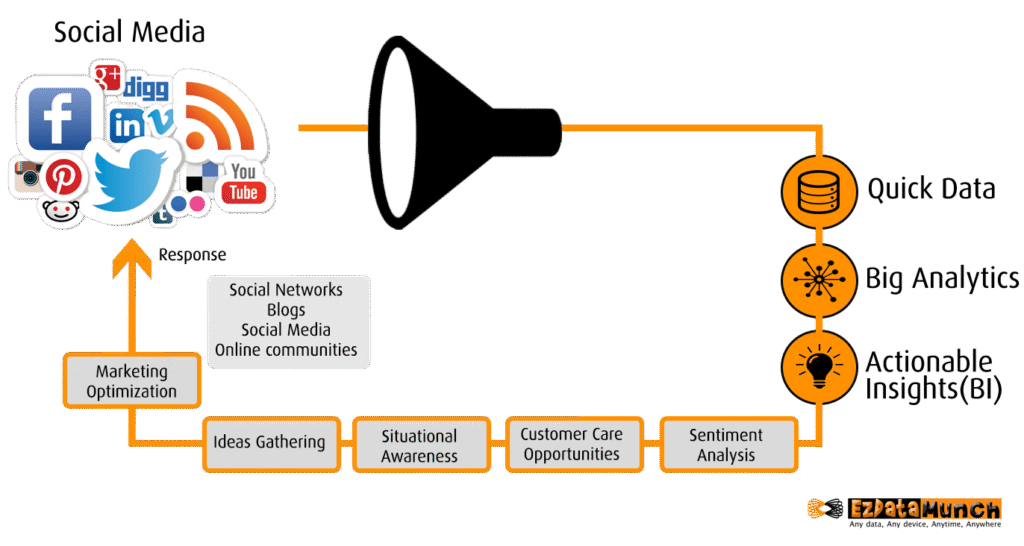
A strategic approach to Social Business Intelligence (Social BI) allows organizations to convert massive volumes of social data into meaningful insights that improve marketing, customer experience, and business growth. Social BI follows a structured flow from gathering social interactions to transforming them into powerful business decisions, demonstrating the role of business intelligence in modern business.
Advantages of Integrating Social Media and Business Intelligence
Real-Time Data
Social media interactions, such as likes, shares, comments, and conversions, provide real-time data. This data can be leveraged as a dynamic source for analysis. By using these insights, businesses can monitor the success of campaigns, evaluate product performance, launch new products effectively, and optimize services. Customer feedback through comments also helps improve product quality and plan for future business growth.
Enhanced Customer Satisfaction
Access to accurate and clean real-time data enables businesses to make informed decisions promptly. Companies that leverage this workflow can improve customer satisfaction, increase loyalty, and ultimately strengthen brand trust. Social BI ensures businesses respond to customer needs efficiently, fostering long-term relationships and meeting the goals of business intelligence.
Relevant Messaging and Data Accuracy
High engagement on posts indicates that the content and offers are relevant and trustworthy. Social media users typically interact with brands and products they perceive as authentic. Accurate insights from these interactions help businesses create targeted messaging that resonates with the audience and avoids misalignment with customer expectations.
Competitor Monitoring and Strategic Planning
Social BI allows businesses to track competitor activities and market trends in real time. These insights provide opportunities to develop new strategies, innovate, and maintain a competitive edge. By analyzing competitor performance, companies can identify gaps, predict market shifts, and position themselves strategically.
Understanding Customer Behavior and Buying Patterns
Social BI gathers insights into customer purchasing behavior and preferences based on interactions, comments, and engagement. These analytics help businesses understand how customers think and act, enabling personalized marketing, improved product recommendations, and more effective sales strategies, showing how does business intelligence work in practice.
Applications of Social Business Intelligence
The core functionality of Social Business Intelligence (Social BI) is like traditional business intelligence (BI) to generating reports, dashboards, visualizations, and actionable insights. However, Social BI brings modern enhancements that make it more agile, user-friendly, and capable of handling the evolving nature of data.
Faster Response and Insights
Traditional BI processes were often time-consuming, requiring significant effort from IT teams to generate reports and analyze data. With the rise of Social BI, big data platforms and self-service analytics tools allow business users to access insights quickly. This drastically reduces the time needed to make data-driven decisions and respond to changing market conditions, emphasizing the role of business intelligence in modern business.
Handling Structured and Unstructured Data
While traditional BI primarily focuses on structured data in tabular or relational formats, Social BI can analyze both structured and unstructured data. This includes social media posts, customer reviews, comments, and other forms of digital interactions, providing a more holistic understanding of customer behavior and market trends.
Enhanced Applications Across Business Functions
Social BI extends BI applications beyond conventional reporting. It plays a critical role in customer engagement, product development, marketing optimization, and operational efficiency. Organizations can leverage Social BI to interact with customers more effectively, gain faster insights, and continuously evolve their strategies to remain competitive in a data-driven world using a reliable business dashboard solution.
Driving Innovation and Continuous Improvement
The evolving capabilities of Social BI encourage businesses to adopt new applications and tools, replacing outdated methods. By embracing these modern BI approaches, organizations can innovate their data processes, enhance collaboration across teams, and achieve measurable business outcomes faster, aligning with the goals of business intelligence.
How Social BI Helps in Business Success
Social media and social networks significantly influence the behaviors and decisions of both customers and business users. These platforms are beneficial not only for customers but also for businesses, as they provide valuable insights into user preferences, opinions, and interactions. Customers frequently share information, reviews, and ideas about products and services, creating a rich data source for businesses.
This is where Social Business Intelligence (Social BI) comes into play. Social BI tracks and analyzes user interactions such as likes, shares, comments, and reviews to help businesses generate dashboards that visualize this engagement, a prime example of a modern business dashboard solution. By monitoring these social signals, business users can gain actionable insights, refine products, improve services, and enhance customer experiences.
When social media and social networking data are integrated into a business intelligence environment, business users can share, rate, discuss, and learn from one another, fostering a more collaborative and informed workplace.
Key ways Social BI contributes to business success include:
- Enhanced Collaboration and Productivity: Teams can work together more efficiently by accessing and sharing relevant insights.
- Interactive Engagement: Users can comment, rate, and share posts, helping businesses understand what data and insights are most valuable.
- Informed Decision-Making: Collaborative analysis encourages more accurate and confident decisions across departments.
Balanced Data Strategy: Social BI helps balance data quality with popularity, ensuring insights are both reliable and relevant.
By analyzing the social dimension of data, including its popularity and relevance, organizations can identify the types of information that provide the most value to users. This understanding empowers businesses to make informed decisions about expanding data resources, generating additional reports, and creating targeted dashboards for better business outcomes, showing how does business intelligence work in action.
Conclusion
Social BI is transforming how businesses collect, analyze, and act on data from social and digital channels. By enabling self-service analytics and fostering collaboration across teams, it helps organizations gain deeper customer insights, make faster decisions, and drive overall business success.
For businesses looking to get started with Social BI, tools like EzDataMunch offer an easy, user-friendly platform to analyze and visualize data. You can register for free on EzDataMunch and start leveraging social business intelligence, business dashboard solutions, and the principles of modern BI to unlock actionable insights, understand the role of business intelligence in modern business, and achieve your goals of business intelligence today.
FAQ’s
What is Social BI?
Social BI (Social Business Intelligence) is the practice of analyzing data from social media channels to understand customer behavior, brand sentiment, trends, and market opportunities.
How does Social BI help improve business decisions?
Social BI provides real-time insights into what customers think, want, and expect. This helps businesses make informed decisions around marketing, product development, customer service, and brand strategy.
What type of data does Social BI analyze?
It analyzes social media posts, comments, hashtags, reviews, engagement metrics, sentiment, competitor conversations, and industry trends across platforms like Facebook, X, Instagram, LinkedIn, and YouTube.
Which businesses can benefit from Social BI?
Any business that relies on customer insights—retail, telecom, healthcare, finance, hospitality, and SaaS companies—can use Social BI to improve brand visibility, customer engagement, and strategic planning.

Abhishek Sharma
Website Developer and SEO Specialist
Abhishek Sharma is a skilled Website Developer, UI Developer, and SEO Specialist, proficient in managing, designing, and developing websites. He excels in creating visually appealing, user-friendly interfaces while optimizing websites for superior search engine performance and online visibility.